
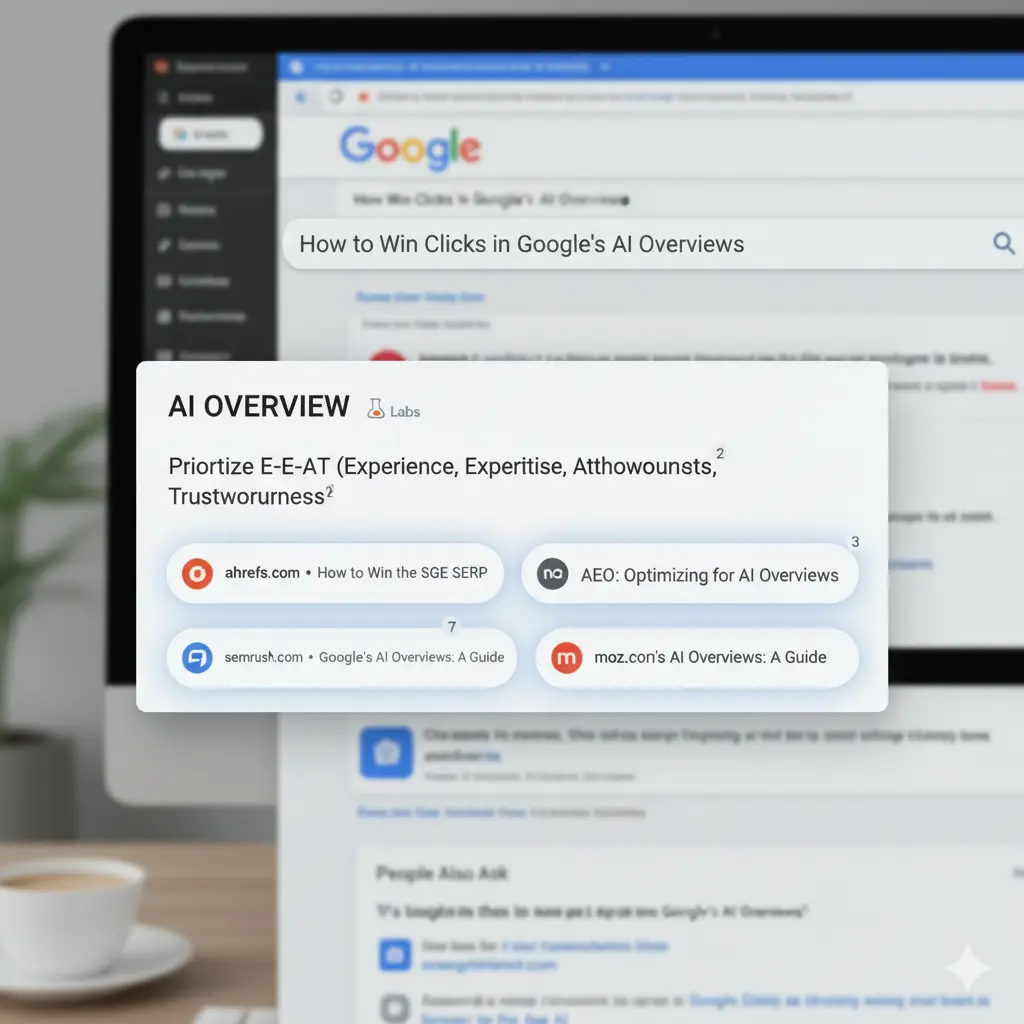
Bottom line: AI Overviews (AIO) sit above blue links and can siphon clicks. You’ll earn traffic by (1) getting cited inside the AIO and (2) standing out just below it with distinctive, source-rich content.
What AIO prefers
- High-quality, corroborated sources. Google’s Gemini-based system cross-checks with core ranking systems + Knowledge Graph before surfacing citations.
- Specific, useful answers. Google says content that resolves the task (clear steps, data, constraints, safety) is more clickable within AIO.
The click reality (why this matters)
Independent analyses show AIO can depress CTR for top organic results; some user surveys find very low link engagement inside the summary. Don’t rely on position #1 alone—optimize for AIO inclusion and post-AIO differentiation.
The Playbook: From “Eligible” to “Irresistible”
1) Engineer citation-worthy pages
- Answer first, then deepen. Open with a tight, scannable answer box (bullets, steps, table), then the narrative.
- Entity clarity. Use precise names, versions, model numbers, places; link to authoritative references to strengthen Knowledge Graph ties.
- Structured data. Add FAQ, HowTo, Product, Organization, and author schema (credentials!)—especially for YMYL topics.
- E-E-A-T on page. Real bylines, bios, citations, and methods sections increase trust—and AIO inclusion odds.
2) Make your snippet the one users click
- Distinctive assets: Original charts, checklists, and mini-tables that AIO can quote—and that stand out below the AIO.
- Freshness beats fluff: Timestamp updates and add “what changed” notes on volatile topics; studies show informational queries are most affected by AIO.
- Opinionated utility: Add a short take (“We recommend X for Y”) plus safety/constraints. Google’s own messaging highlights helpfulness + guardrails.
3) Format for the Overview and the click
- Short, labeled sections (Problem → Steps → Caveats → Sources).
- Source list with anchors (so AIO—and humans—can cite the exact part). MLA also advises: cite the source, not the AIO.
- Comparisons win: 1-screen comparison tables for products, policies, or timelines.
4) Don’t ignore distribution shifts
With AIO rising across query classes, build for visibility beyond SERP #1: newsletter summaries, embedded social cards, and internal recirculation from older posts.
Quick Checklist (ship this with every post
- 50–120-word “answer” block at top
- At least 3 primary sources (gov, standards, original data)
- FAQ or HowTo schema added
- Freshness note + last updated date
- Author bio with credentials/experience
- One original chart/table + downloadable asset
Team Prompts (paste into your editor brief)
- Outline prompt: “Draft a 6-section outline answering [query]. Include an ‘Answer in 100 words’ intro, 3 FAQs, and a 4-row comparison table. Cite sources.”
- Fact-check prompt: “List 5 claims that need verification. For each, propose an authoritative source to corroborate.”
- Snippet prompt: “Write a 40-word meta description and a 120-character excerpt using the main keyword and a benefit.”
Metrics to watch (beyond rank)
- AIO presence rate on your target queries and citation rate for your pages.
- #1 CTR with vs. without AIO (expect drops; aim to narrow the gap).
- Referral mix change (search → newsletter/direct/social) post-AIO launches.