
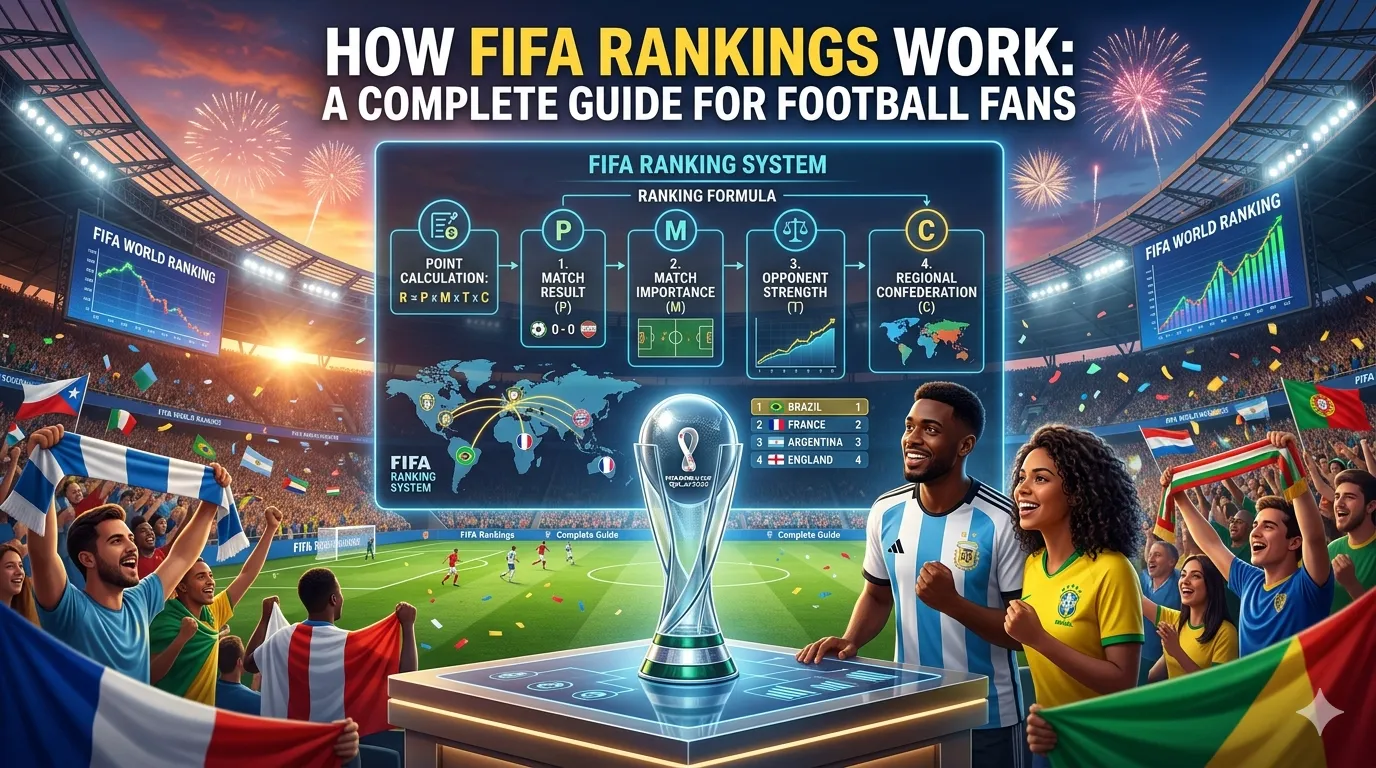
How FIFA Rankings Work: A Complete Guide for Football Fans
Introduction
If you’ve ever wondered why Argentina sits above France in the FIFA World Rankings or how a country’s ranking changes after a win or loss, you’re not alone.
The FIFA World Rankings are one of the most discussed and debated systems in international football. Fans, coaches, players, and analysts closely follow the rankings because they influence tournament seedings, World Cup qualification draws, and global football prestige.
But how exactly do FIFA rankings work?
In this complete guide, we’ll break down the FIFA ranking system, explain how points are calculated, and reveal why some teams rise while others fall.
What Are FIFA Rankings?
The FIFA World Rankings are a system used by FIFA to rank men’s national football teams based on their recent performances.
The rankings were introduced in December 1992 to provide an objective way of comparing national teams from different continents and competitions.
Today, the rankings are updated regularly and play a major role in international football.
Why FIFA Rankings Matter
Many football fans think rankings are just numbers.
In reality, rankings affect several important aspects of the game:
1. World Cup Seeding
Higher-ranked teams often receive better positions in World Cup draws.
This can help avoid facing other top nations in the early stages.
2. Tournament Draws
Competitions such as:
- FIFA World Cup
- Continental Championships
- Qualification tournaments
often use rankings to determine seeding pots.
3. National Prestige
A high FIFA ranking reflects consistent international success and boosts a nation’s football reputation.
4. Sponsorship Opportunities
Higher-ranked teams generally attract more media attention and commercial partnerships.
How FIFA Rankings Are Calculated
FIFA currently uses a ranking formula known as the:
SUM Method
This system was introduced after the 2018 FIFA World Cup.
Instead of averaging results over a period, the SUM method adds or subtracts points after every match.
This approach rewards current performance more accurately.
The FIFA Ranking Formula
The simplified formula is:
P = Pbefore + I × (W – We)
Where:
- P = New Ranking Points
- Pbefore = Previous Ranking Points
- I = Importance of Match
- W = Actual Result
- We = Expected Result
This formula means teams gain points when they perform better than expected and lose points when they perform worse.
Understanding Match Importance
Not all matches carry equal value.
FIFA assigns different importance levels depending on the competition.
Friendly Matches
Importance Value: 10
Examples:
- International friendlies
- Exhibition matches
These have the smallest impact on rankings.
Nations League Matches
Importance Value: 15–25
These matches carry more weight because they are competitive.
World Cup Qualifiers
Importance Value: 25
Qualifying matches significantly influence rankings.
Continental Championships
Examples:
- UEFA European Championship
- Copa América
- AFC Asian Cup
- Africa Cup of Nations
Importance Value:
- Group Stage: 35
- Knockout Rounds: Higher values
FIFA World Cup Matches
Importance Value:
- Group Stage: 50
- Knockout Rounds: 60
World Cup matches have the biggest impact on rankings.
This explains why rankings often change dramatically after a World Cup.
How Winning and Losing Affects Rankings
Let’s imagine:
Team A Ranked #5
Team B Ranked #75
If Team A defeats Team B:
- Team A gains only a few points
- Expected result achieved
However, if Team B wins:
- Team B gains many points
- Team A loses significant points
This system rewards upsets and penalizes unexpected defeats.
Why Strong Opponents Matter
The ranking formula considers the strength of your opponent.
For example:
Defeating:
- Argentina
- France
- Spain
- Brazil
earns more points than defeating lower-ranked nations.
As a result, teams cannot simply climb the rankings by beating weaker opponents.
How Draws Affect Rankings
Draws can also influence rankings.
Examples:
Lower-Ranked Team Draws With Brazil
Result:
- Gains ranking points
Brazil Draws With Lower-Ranked Team
Result:
- May lose ranking points
Because the outcome was worse than expected for the stronger team.
Current FIFA Ranking Powerhouses
Historically, several nations consistently rank near the top:
Argentina
World Cup champions and one of the strongest international teams.
France
Regular contenders in major tournaments.
Spain
Known for technical football and consistent performances.
England
One of Europe’s most talented squads.
Brazil
The most successful nation in World Cup history.
These teams frequently exchange positions at the top of the rankings depending on recent results.
Criticisms of FIFA Rankings
Despite improvements, the system still faces criticism.
1. Different Confederation Strengths
Some fans argue:
- UEFA competition is stronger
- CONMEBOL matches are more difficult
Yet all teams are ranked using the same formula.
2. Friendly Matches Still Count
Although friendlies have lower importance, they still influence rankings.
Some analysts believe they should have even less impact.
3. Tournament Opportunities Vary
Countries in different regions may have varying numbers of competitive matches.
This can affect ranking progression.
Which Nation Has Been Ranked Number One the Most?
Historically, several football giants have spent long periods at the top:
- Brazil
- Spain
- Germany
- Belgium
- Argentina
Brazil remains one of the most dominant teams in ranking history due to decades of consistent success.
FIFA Rankings vs Actual Team Strength
A common misconception is that rankings always identify the world’s best team.
In reality:
Rankings measure:
- Results
- Consistency
- Recent performance
They do not always predict:
- Future success
- Tournament winners
- Head-to-head outcomes
Football remains unpredictable, which is one reason fans love the sport.
How Teams Improve Their Ranking
National teams can climb the rankings by:
Winning Competitive Matches
World Cup qualifiers and major tournaments provide the largest point gains.
Beating Strong Opponents
Upsets produce substantial ranking boosts.
Maintaining Consistency
Avoiding losses is often more important than chasing occasional big wins.
Performing Well in Major Competitions
Deep tournament runs can dramatically improve rankings.
Interesting FIFA Ranking Facts
- Belgium spent years ranked number one despite not winning a World Cup.
- Argentina rose significantly after winning major international trophies.
- Small football nations can rapidly climb rankings with a few strong qualification campaigns.
- World Cup results often trigger the largest ranking movements.
Final Thoughts
The FIFA World Rankings provide a fascinating snapshot of international football’s competitive landscape. While no ranking system is perfect, FIFA’s modern SUM formula does a much better job of reflecting current team strength than previous methods.
Understanding how rankings work helps fans appreciate why national teams move up and down the standings and why every international match matters.
Whether you’re following your country’s World Cup journey or simply tracking football’s global powerhouses, FIFA rankings remain one of the most important tools for measuring success on the international stage.